
World’s Fastest Deliveries Ignite an Investment Frenzy in India
Startups are jostling with Amazon and Walmart to turn 10-minute commerce into a $100 billion market.
A few miles from the bustling, labyrinthine markets of Old Delhi — where traders have hawked spices and textiles for centuries — a quiet patch of low-slung warehouses hums with a radically different form of commerce. From here, India is executing one of the boldest bets in modern retail: delivering nearly anything to your doorstep in less time than it takes to hard-boil an egg.
India’s instant commerce revolution is gathering extraordinary pace, fueled by surging demand, rising competition and billions of dollars in global investor capital. Startups are jostling with Amazon.com Inc. and Walmart Inc.’s-backed Flipkart to blanket the nation’s cities with small, hyperlocal warehouses and delivery riders — promising groceries, electronics, and in some cases, even gold coins in under 10 minutes.
It’s a model that has burned through mountains of cash — and flamed out — in nearly every other major market. Yet investors are betting that India will be different. With dense cities, low labor costs, and a rising class of more than 730 million digital-first Gen Z and millennial consumers accustomed to instant services, the country may be the one place where 10-minute delivery can finally work at scale.
SoftBank Group Corp., Temasek Holdings Pte. and Tencent Holdings Ltd. are among global investors — many of whom saw similar models crash in the US and Europe — pouring billions into India’s instant commerce race.
The market is expected to balloon to $100 billion in sales by 2035, from $6 billion now, according to Bloomberg Intelligence. That would make it nearly a fifth of the country’s overall e-commerce sales, up from just 5% today.
Barely five years old, the sector has already seen explosive growth. Blinkit, snapped up by Eternal Ltd. (then known as Zomato) for about $570 million just three years ago, is now worth at least $15 billion, according to some analysts. Zepto, valued at $6 billion, is eyeing a public listing next year. Swiggy Ltd., whose Instamart is another industry heavyweight, is valued at $12 billion, with its quick-commerce arm estimated to account for roughly 40% of that.
But BI and other analysts warn the euphoria is outpacing fundamentals. Valuations are inflating fast, margins are razor-thin, and the space is teeming with near-identical competitors — all chasing the same impatient customer.
For now, companies are spending heavily to offer incentives, operating at a breakneck pace to outlast rivals — with investors underwriting the losses. If consumer discounts are pulled, the model could quickly unravel.
“We’ve entered a hype cycle in quick commerce,” said Varun Laijawalla of London-based asset manager Ninety One.
An early investor in Eternal, Laijawalla removed it from his fund’s portfolio late last year. “Expectations are rising quickly,” he said. “We know what happens on the other side.”
India’s top three quick commerce firms have collectively lost more than $1.4 billion (123 billion rupees) over the past four years. This figure does not account for Zepto’s fiscal year 2025 results, which have not yet been disclosed, or Blinkit’s FY22 performance, as it was private until its acquisition.
Swiggy and Eternal declined to comment. In an interview, Zepto co-founder and Chief Executive Officer Aadit Palicha said stores accounting for 60% of their sales had turned profitable in the quarter-ending June.
Scaling Fast, Bleeding Fast

Yet the losses have barely dented momentum. If anything, they underscore how aggressively companies are betting on an idea long dismissed as a logistical fantasy anywhere in the world: mastering the most punishing leg of e-commerce — the last mile — which can account for half of total logistics costs. But three Indian startups — Blinkit, Instamart and Zepto — decided to make it their core offering, building dense dark store networks and squeezing efficiency from India’s urban sprawl.
Amazon’s recent entry, along with Walmart-owned Flipkart’s expansion into quick-commerce last year, is pitting the vast logistics networks of legacy players against 10-minute incumbents built for speed.
This is “unique to India,” said Chandranath Dey, head of India’s logistics and industrial operations at real estate services firm JLL. “It can’t happen in the US, the last mile is exorbitant there with labor cost. In India, it’s a revolution.”
The froth is most pronounced in Eternal, the corporate entity that houses the Zomato and Blinkit brands, according to BI analyst Nathan Naidu. Its valuation premium exceeds that of tech peers in India’s Nifty and Sensex indexes by more than 50%.
Still, structural tailwinds help explain the optimism, and why India could succeed where others haven’t. A rapid shift to digital payments, fueled by affordable smartphones and ultra-cheap data, has converged with gaping holes in traditional retail infrastructure to make the country uniquely suitable for 10-minute delivery. Nearly 890 million Indians are online, transforming how a growing population shops, pays, and expects to receive goods.
In a country where getting an ambulance quickly can feel like a miracle and express mail can take weeks, the idea that you can summon eggs, ice cream or an iPhone in under 10 minutes borders on the absurd. And yet, it works — because India is deeply wired for service.
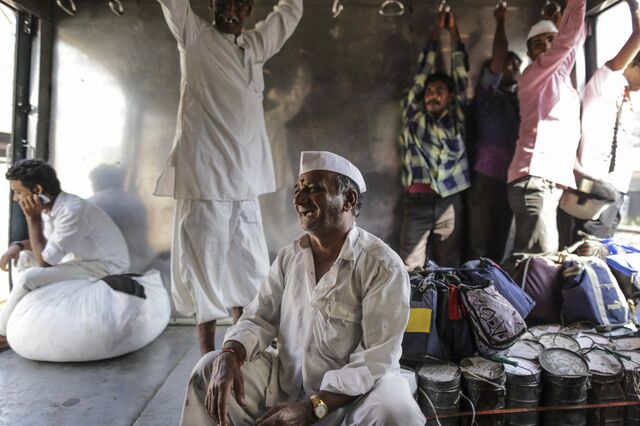
With 1.4 billion people, domestic help is common even in middle-class homes, a reflection not of luxury but of the country’s vast labor pool and deep economic divide. That same dynamic has long shaped commerce, too: for decades, corner shops have sent boys weaving through neighborhoods with deliveries ordered over crackly landlines. The idea of convenience isn’t new; it’s just been streamlined and sped up.
Deep freezers or bulk storage are also largely absent in urban households, as the Indian diet rarely depends on frozen items, and fresh produce and meat are readily available at street vendors. Consumers tend to buy essentials in smaller quantities and more frequently — a habit quick commerce is built to serve.
“Retail in India is hyperlocal,” with an average household making 80% of purchases in a three-kilometer (1.9 miles) radius, Zepto’s Palicha said. "People overwhelmingly make small-ticket purchases multiple times a week." Smaller home sizes and two-wheelers also make bulk buying impractical, he added.
The country’s playbook contrasts sharply to efforts in developed economies, where the model stumbled after the pandemic as consumers returned to shops and restaurants. In the US, Jokr scaled back on promises of instant delivery. Softbank-backed Gopuff, part of Philadelphia-based GoBrands Inc., postponed its IPO amid mass layoffs and warehouse closures. In Europe, Getir retreated after a collapse in valuation and a power struggle with its lead investor, Abu Dhabi’s Mubadala Investment Co.
Closer to home, China’s fastest deliveries generally take 30 minutes.
Here’s a behind-the-scenes look at how a dark store picks, packs and dispatches orders.

At the heart of the model is a hyper-efficient network of dark stores — compact warehouses strategically placed to fulfill orders within a two-mile radius. The facilities resemble micro versions of Costco Wholesale Corp. stores, optimized for efficiency. Popular items like potato chips and onions sit near the entrance; bulkier, less-frequent buys — air conditioners, induction stoves — are shelved farther back.
Some deliver printed documents uploaded via app. A few even stock gold coins. With the promise of precious metals at your doorstep in under 10 minutes, instant noodles and 24-karat bullion can now share the same supply chain.
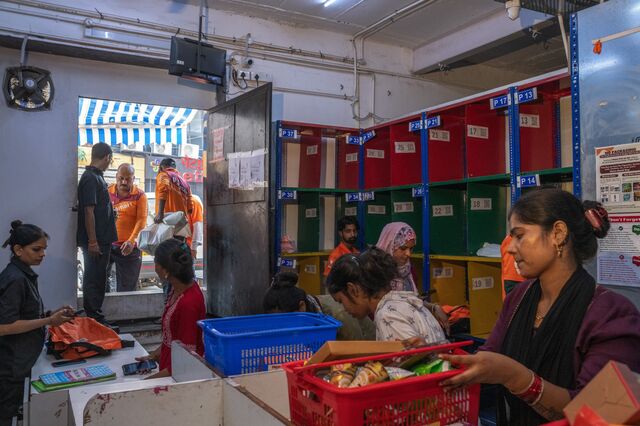
On a recent Bloomberg News visit to a Zepto dark store located next to a Swiggy outlet, delivery riders buzzed about. Some wore Zepto’s deep purple shirts; others sported rival Swiggy’s bright orange. Their mission: ferry items ranging from eggs to electronics in single-digit minutes.
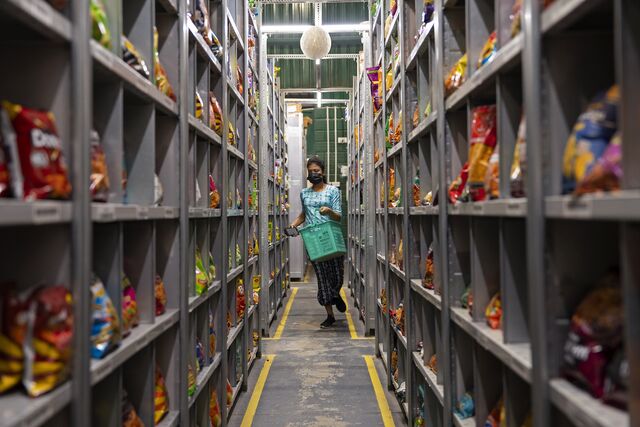
Spanning 4,400 square feet — nearly the size of a basketball court — the store in Gurugram, a satellite city near New Delhi, runs three nine-hour shifts a day. Staff work through the night to replenish stock and prepare for morning surges. Inventory was arranged alphabetically, with high-frequency items closer to the front. In the back, Zepto Cafe dispatched freshly prepared meals.
Pickers moved briskly but deliberately through the aisles, scanning barcodes with one hand and retrieving items with the other. Some scaled ladders with practiced ease, lobbing products down to colleagues stationed below. Others wove between shelves, dropping packs of milk and chips into purple plastic bags that puffed up like parachutes. The space was calm and focused, marked by the soft chirp of scanners and the occasional slap of sandals on concrete — each order packed in under two minutes.
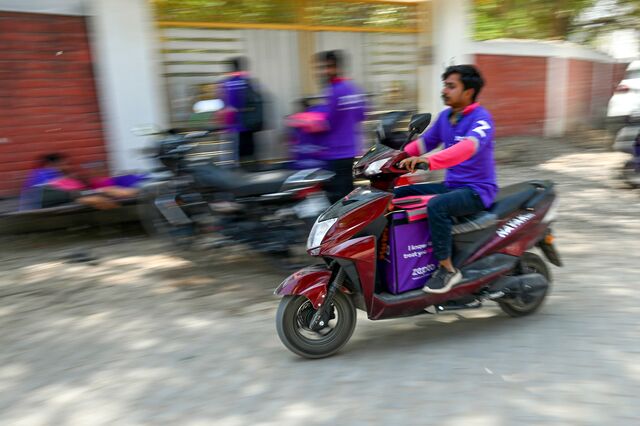
Delivery workers — often paid per order and incentivized to go faster — cross-checked the items and sped off on their two-wheelers, whizzing past gridlocked cars and zipping through back alleys to drop things off in under eight minutes.
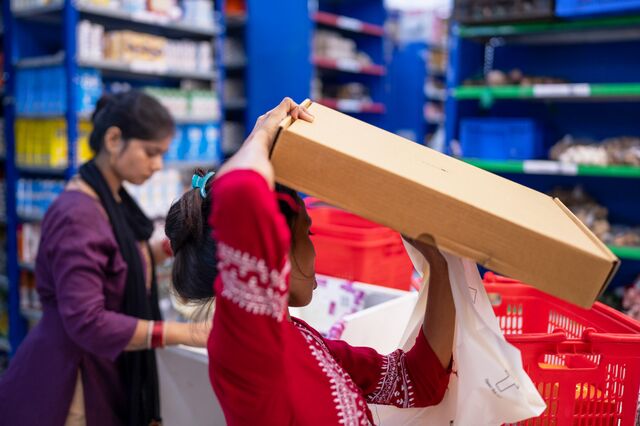
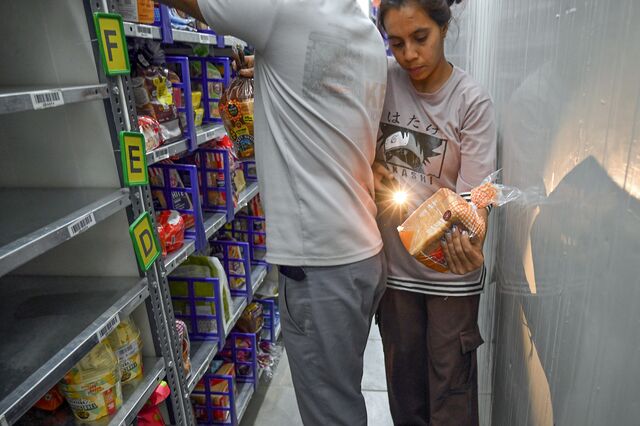
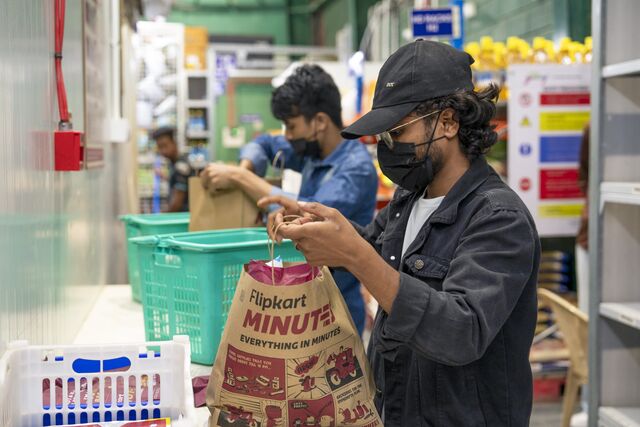
Quick commerce players now boast thousands of these mini warehouses, most of them franchised. Blinkit operates more than 1,500 dark stores in more than 100 cities; Zepto has more than 1,000 in 40 cities; and Swiggy runs 1,062 shops spanning 127 cities.
But the rapid expansion of this new retail model is rippling far beyond the warehouses. As tech-savvy entrepreneurs build mini empires powered by software and scooters, many mom-and-pop shops are shuttering, and some gig workers are protesting. More than 200,000 stores shut down last year, according to a retailers’ union, sparking calls for regulation. Gig workers, meanwhile, are pressing for fair pay and better working conditions.
In Varanasi, hundreds of Blinkit riders went on strike amid a 43C heatwave, demanding fair pay, shade, and heatproof uniforms; many were blocked from the app after the protest. The Telangana Gig and Platform Workers Union has accused Zepto of exploitative labor practices in a complaint with the state’s labor department. Zepto has denied the allegations.
The ascent of Blinkit-owner Eternal into India’s benchmark BSE Sensex index in December, and then the NSE Nifty 50 in March, marked a milestone for India’s quick commerce boom. With a young consumer-tech startup in indices traditionally dominated by banks and energy giants, the inclusion reflected the sector’s growing clout.
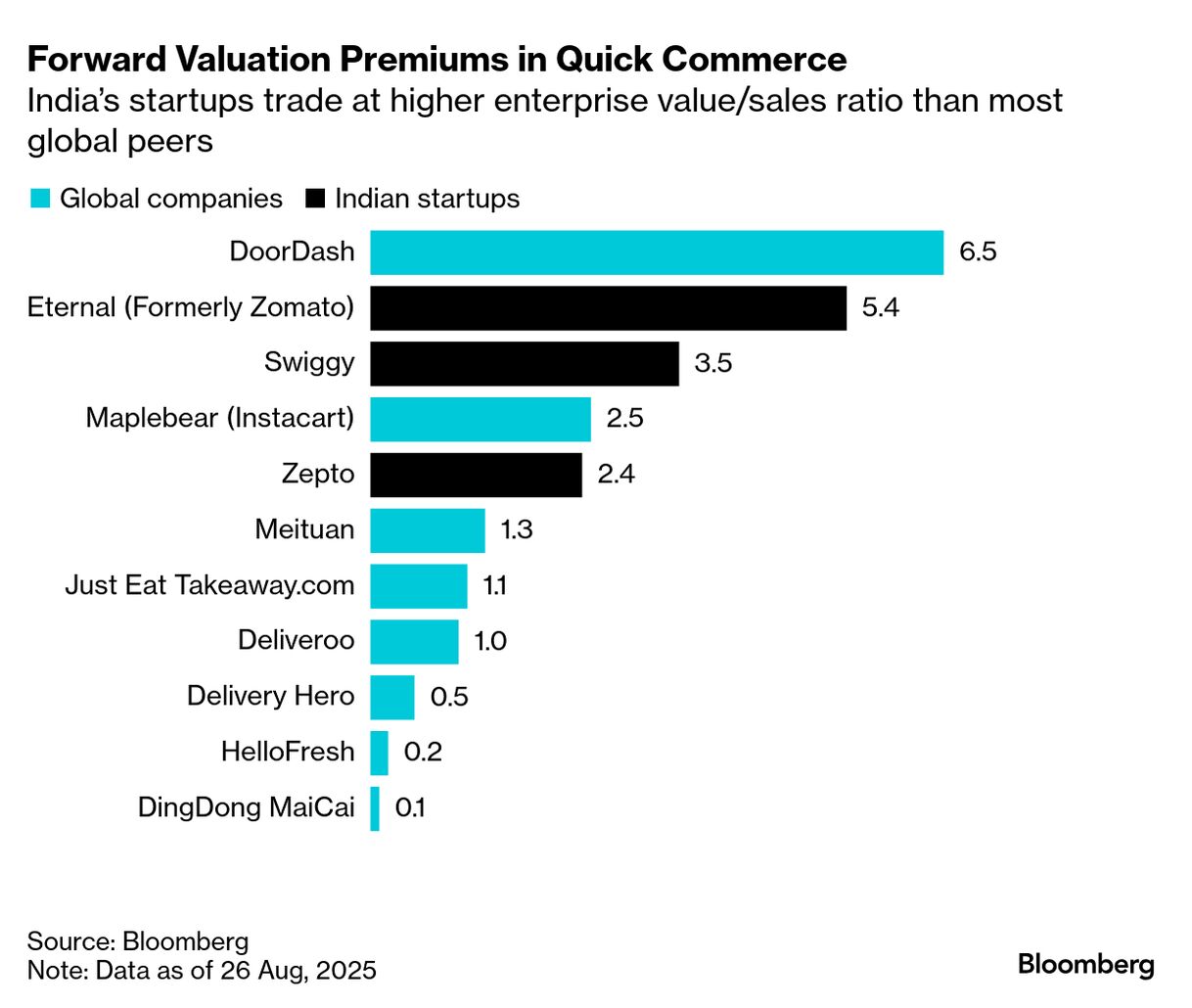
Shares of the company more than doubled in 2024, fueled by enthusiasm for fast delivery. The stock climbed again following its latest earnings report, which showed quick commerce growth holding strong despite new rivals. Still, the premiums are raising red flags. Eternal is trading at more than 140% above its global peers. Swiggy also commands a steep markup of nearly 60%.
Forward Valuation Premiums in Quick Commerce
India’s startups trade at higher enterprise value/sales ratio than most global peers
Analysts expect Blinkit to reach profitability by March next year, while Swiggy isn’t projected to break even for at least another two years. Still, the broader consensus points to modest gains for quick commerce stocks, with nearly 90% of analysts rating Eternal a “buy.”
Breaking from the pack is Aditya Suresh, Macquarie Group’s head of India equity research and Bloomberg’s top-ranked analyst last year. He has issued a rare “sell” rating on both Eternal and Swiggy, forecasting that Eternal’s share price could drop nearly 40% over the next year, and Swiggy’s by 35%.
Suresh raised concerns about the margin trajectory for all the players, saying Blinkit’s desired path from roughly minus 1% margins today to its 5% target is ambitious. “I think the precondition [for profit] is that you got to have benign competition,” he said in an interview. “I don’t buy into the theory of quick consolidation,” he said. “The addressable market is so large, the allure of the prize so big, that a lot of players will throw capital at this.”
Meeting the expectations of quick commerce at scale can be difficult, as seen in neighboring China. Meituan, one of the world’s biggest food delivery operators by order volume, handles roughly 100 million orders daily, commanding at least a third of China’s food delivery market, said BI’s Catherine Lim. Founded in 2010, it turned profitable in 2019. But with increasing competition, its 30-minute grocery delivery service remains unprofitable.
India’s 10-minute sector surged during Covid lockdowns as consumers turned to apps for everything from toothpaste to tomatoes. Today, impulsive orders — like a pinch of salt or a missing spice mid-recipe — are common.
Blinkit and Zepto are market leaders, claiming over 16 million average monthly transacting users each. Swiggy’s Instamart said it has about 11 million.
India’s largest online retailers have been forced to respond to the boom. Amazon, which entered India in 2013 and has yet to turn a profit there, debuted its 10-minute delivery service “Now” in Bengaluru last December and expanded to New Delhi in July. The company plans to scale the service across the country in the coming months and said it’s seeing early traction in “near-instant delivery.”
Amazon’s edge lies in its nationwide logistics network that can reach every serviceable postal code, a company spokesperson said in an email. “Rather than viewing quick commerce as separate from our core business, we see it as a natural extension that leverages existing strengths while meeting evolving customer expectations.”
While the nation contributes only a sliver to Amazon’s global e-commerce revenue, its user base of more than 100 million presents a ripe market. Having exited China in 2019 after failing to gain ground there, the e-commerce giant is unlikely to pull punches in India, said BI’s Naidu.
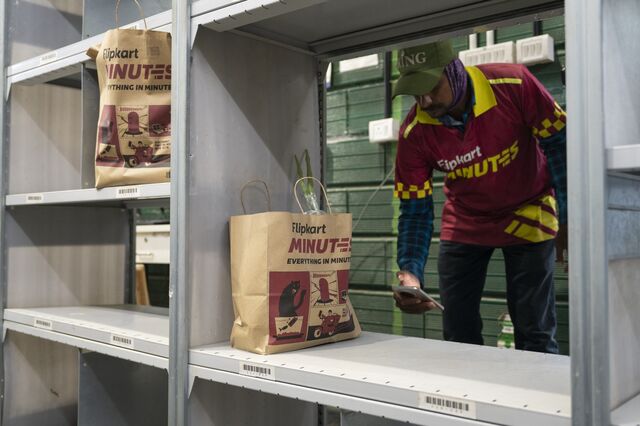
Loss-making rival Flipkart, which plans to go public next year, launched its 10-minute service ‘Minutes’ last year. Asia’s richest man Mukesh Ambani’s JioMart has not yet followed suit, but the Reliance Retail unit’s recent rollout of a 30-minute delivery service could signal it’s not far behind.
“Greater convenience is a one-way street, and you can’t come back,” said Rajesh Nanarpuzha, a professor of marketing at the Indian Institute of Management in Udaipur. “An Amazon delivery that takes one to two days seems too long,” he said.
The current model — subsidizing goods and losing money on orders to gain market share — hinges on long-term dominance. But in price-sensitive India, customer loyalty is fickle.
Discount Wars in Quick Commerce
India’s ten-minute delivery apps are undercutting retail to win customers

“I buy from whichever app has the best offers,” said Kiran Gangwa, who is a dark store franchisee for multiple brands. She also relies on the apps for her own household needs. “Everyone has to save money.”
Consumer brand agnosticism extends to franchisees like the Gangwas, who hedge their bets by operating outlets for more than one quick-commerce company. The economics can be alluring: franchisees invest nearly 8 million rupees ($92,000) per store and earn up to 3% monthly returns, Kiran’s husband Anil Gangwa told Bloomberg News.
In an effort to boost margins, Zepto and Swiggy have launched their own private labels for groceries and meat. Blinkit is now buying directly from brands in a move that bypasses intermediary markups.
And advertising has quietly become an important revenue stream, offering a rare path to margin. With around 40% of searches on these apps being for specific products — “Lay’s chips” rather than just “chips,” for instance — companies are increasingly able to sell high-value, targeted ad slots, according to a report by Elara Capital. Blinkit, Instamart and Zepto are already making hundreds of millions of dollars in ad sales, the report said.
New formats like Zepto Cafe’s rapid-fire snacks and Swiggy Bolt’s speed-run meals also mark the next frontier of growth. Zomato, meanwhile, pulled the plug on its 15-minute prepared-food delivery after it proved unprofitable, underscoring the challenge of balancing speed with sustainable margins.
“The heating up of the market means more cash burn and losses for everyone,” said Satish Meena, founder of retail research firm Datum Intelligence. Many players are unlikely to turn a profit without loyalty programs or steeper service fees, he said.
Flipkart, which launched its 10-minute service “Minutes” a year ago, said it has expanded to 19 cities in its first 12 months. Its fastest delivery to date — completed in Bengaluru — clocked in at just 3 minutes and 21 seconds.
“We are balancing rapid expansion with efficiency through technology, dark store density, and deep integration,” a company spokesperson said in an email, referring to working closely with their in-house delivery logistics unit on the last-mile network. “This ensures that while we invest in scaling, we are also building a path to sustainable economics.”
India is not alone in navigating the promises and pitfalls of quick commerce. Colombia-based Rappi Inc. stands out as a rare success story outside India, with its Turbo service offering 10-minute grocery delivery in at least seven Latin American countries, including Mexico, Brazil, and Chile. Analysts credit similar dynamics: low labor costs, urban density, and a growing digital economy. Rappi, valued at $5 billion, is now planning an IPO.
“You couldn’t have asked for a better environment to start quick commerce in India right now,” said Pranav Pai, founding partner at Bengaluru-based venture firm 3one4 Capital. “But startups cannot keep giving discounts forever, and it’s near impossible to break even doing that.”