

Your Guide to Trump’s Day-One Agenda — From Taxes to Tariffs
Emboldened by his triumph, the president-elect will enter the White House in January ready to make good on these MAGA campaign promises.
The opening of Donald Trump’s second term will be unlike any US government transition the world has seen in the modern era: It promises to combine the sharp policy break of a new presidency with an incumbent’s mastery of the levers of power.
The Republican emerged from Tuesday’s election in a stronger position than even many allies anticipated and prepared to move swiftly on core economic priorities such as raising tariffs, cutting taxes and cracking down on undocumented migrants.
And with a roster of loyalists set to join him in the White House — filling roles that in his first term were often held by establishment GOP figures or institutionalists who didn’t necessarily share Trump’s goals — his ambitions will be amply abetted.
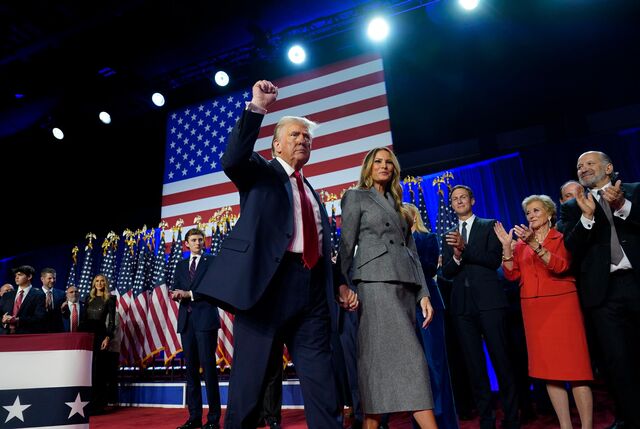
“It’s expanded everybody’s sense of what’s possible,” Mike McKenna, a first-term Trump White House adviser who is now an energy lobbyist, said of the election results.
Trump not only was on track Friday to win a majority of the national popular vote — a feat he didn’t achieve in 2016 — but had already swept out of office several long-serving Democratic senators, giving Republicans control of the chamber.
On the campaign trail, Trump regularly declared that on his first day in office, he would launch the “largest deportation effort in American history” targeting undocumented migrants. In addition to the human toll, that would immediately hit economic sectors such as construction, hospitality and retail that rely heavily on migrants, legal and undocumented.
Trump reaffirmed the promise Thursday in an interview with NBC News, saying he had “no choice” but to honor his commitment and “it’s not a question of a price tag.” He can order the deportation program on his own authority and the obstacles are primarily logistical, such as finding facilities to place detainees. Stocks in private prison companies, which offer a solution, soared after the election.
Trump’s Path to Enacting Policies
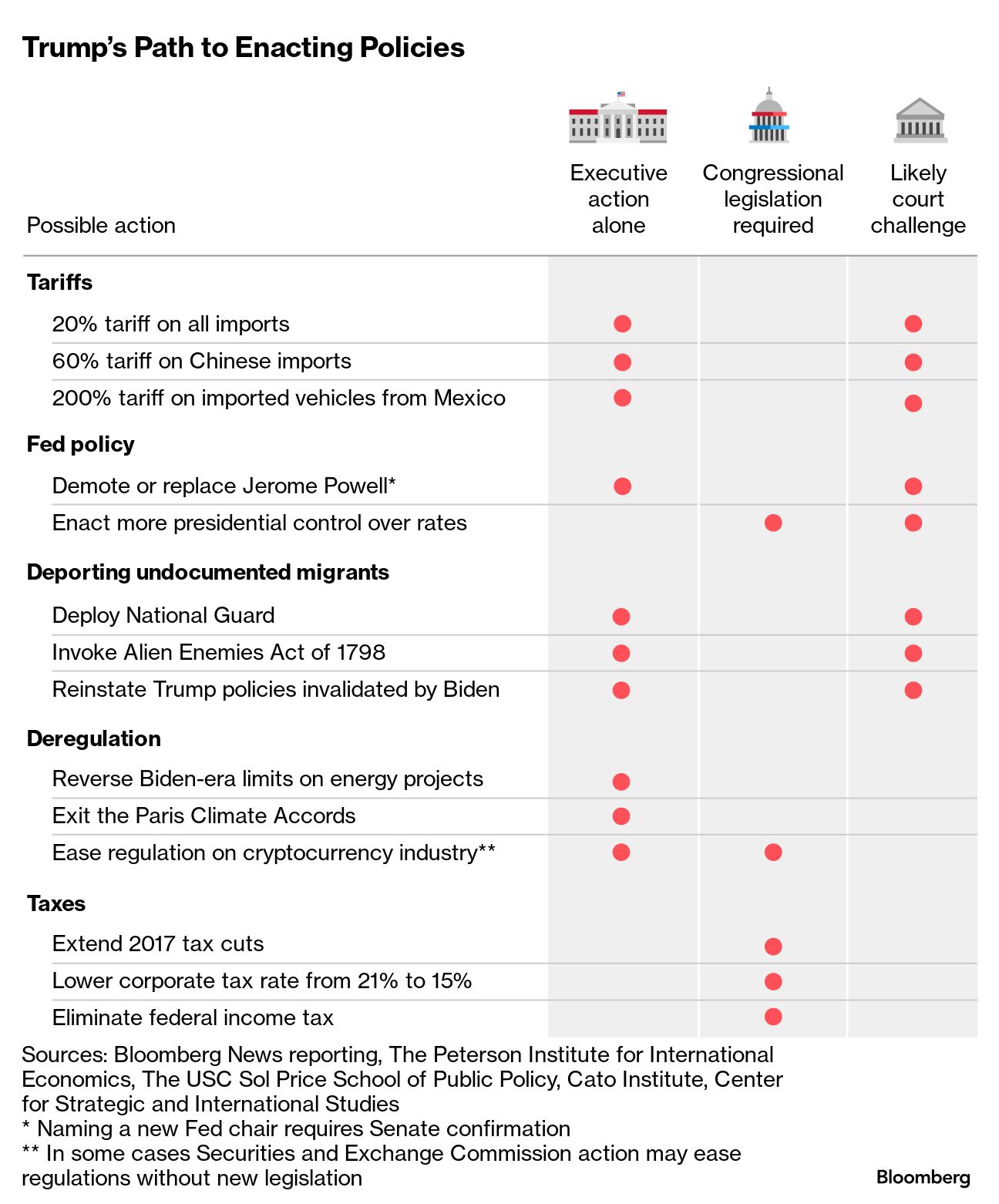
** In some cases Securities and Exchange Commission action may ease regulations without new legislation Sources: Bloomberg News reporting, The Peterson Institute for International Economics, The USC Sol Price School of Public Policy, Cato Institute, Center for Strategic and International Studies
In many cases, the incoming administration has game plans left over from the first Trump term.
“This isn’t brain science, it's common sense. We’ve done it before, we’ll do it again,” said Mauricio Claver-Carone, a veteran of the first Trump administration, citing a list of immigration measures that can simply be reinstated.
Trump named a White House chief of staff, Susie Wiles, less than 48 hours after polls closed. Washington was awash in speculation about who else would have key positions.
The emerging role of Elon Musk as an informal adviser could be a wild card in the administration. Musk joined a call Trump had Wednesday with Ukrainian President Volodymyr Zelenskiy.
Some key Trump goals such as his tax cut plan depend on congressional approval. But Republicans are closing in on unified control of Washington, with at least 53 GOP senators and party leaders increasingly confident they will maintain their slim majority in the House.
Republican congressional leaders are far more beholden to Trump than in his first term, with stalwart Senator Mitch McConnell giving up his leadership post at the end of this year. In the House, Trump has the power to make or break leaders. Speaker Mike Johnson and other top GOP House leaders flew to Florida on election night to show their loyalty to Trump.
No more than two of the 10 House Republicans who voted to impeach Trump after the Jan. 6, 2021, insurrection and three of the seven Senate Republicans who voted to convict him will still be in Congress when Trump takes the oath of office.
Still, the slender Republican majorities in both chambers leave Trump vulnerable to defections whenever his agenda provokes a public backlash.
Not everyone will roll over for the new president. Federal Reserve Chair Jerome Powell — whose term doesn’t expire until 2026 — was pressed by reporters on whether he would step down from his post if Trump asked. His answer was direct: “No.”
Market reaction is another constraint. Treasury borrowing costs have already risen on the prospect of a higher debt load. Tariffs hitting corporate profits could flip stock market sentiment from greed to fear.
But Trump, never shy about wielding power, enters office brimming with confidence. At his election celebration, he claimed the results amounted to “an unprecedented and powerful mandate.”
Here are key policy areas for administration efforts from day one:
Tariffs
Trump has vowed to impose massive new tariffs, eyeing a duty of 20% on all foreign goods and 60% or higher on goods coming from China. On the campaign trail, he also dropped threats of even-higher rates on specific countries and products.
He faces relatively few constraints in imposing his promised tariffs and doesn’t need to consult with Congress. A 1977 law gives him authority to impose duties in cases of an “unusual and extraordinary threat” to national security, foreign policy, or the US economy. Alternatively, he could use other legal provisions he invoked in his first term to raise some tariffs. Those require a public comment period, which add a delay.

Some Trump advisers have suggested he might use the threat of tariffs as a negotiating tactic with allies and rivals alike and back off the notion of imposing them across the board. Others have suggested that Trump is truly serious this time about rewriting the rules of international trade, no matter the consequences. He’s also pointed to tariffs as a way to help pay for the big tax cuts he’s promised, though economists argue they won’t raise nearly enough money. In either case, tariffs are expected to play an even larger role in his second term.
“We advise readers to take the president-elect’s threats of tariffs seriously if not literally,” Wells Fargo & Co. economists Jay Bryson and Michael Pugliese said in a note to clients Wednesday.
What Bloomberg Economics Says:
On the campaign trail, Trump pledged tariffs of 60% on China and 20% on everyone else. In office, it's unlikely he'll go that far. Trump views tariffs as a bargaining tool. He may deny they pose risks to growth, inflation, and corporate profits. Markets will beg to differ. With companies like Apple Inc. in the firing line, a major drop in stock prices could give Trump pause. Views within his administration will likely be divided, with advocates like Robert Lighthizer facing off against pro-market pragmatists. Practicalities like assembling teams and designing tariff lists mean implementation will take some time.
A plausible base case is that threats start immediately, adding uncertainty for business and investors. Actual tariffs may follow either in the first quarter of 2025 or the second half of the year, depending on the procedure used. Tariffs may be launched at different times and selectively applied to different countries and products. If tariffs on China rise to 30%, with a 5% rate on other countries, the average would increase to 8.5% from 2.6%. This scenario could reduce the US global trade share from 20% to 16% by 2028, modestly slow growth and raise inflation. Dollar appreciation and retailers absorbing tariffs through lower margins may further offset the inflation impact. If only China is targeted — and market champions like Apple get a carve-out — the impact on the US could be contained.
Trump’s Tariff Plans Would Bring Rates to Highest in Decades
Average tariff levels on goods under different scenarios
The Fed
Trump’s victory has already shaken things up for the Fed. His economic agenda could well spur both growth and inflation. Investors have responded by dumping US Treasury bonds, prompting a slew of economists to rethink their expectations for how quickly the Fed will continue lowering interest rates in 2025. Powell said Thursday the central bank won’t be altering its outlook for rates in anticipation of new fiscal or trade policies and will wait to see what’s actually enacted.
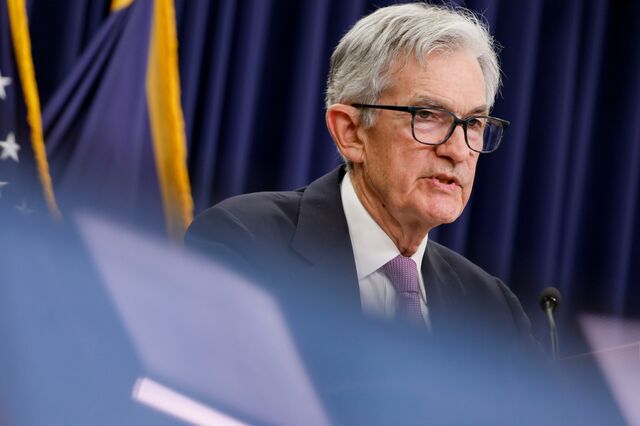
Then there are questions about what Trump might do to more directly influence the central bank. The former president has a history of hectoring Powell over rates and, in his first term, explored the possibility of demoting him from the chair. Trump has more recently said he would let Powell serve out his term as chair, which expires in May 2026. But it would hardly be a surprise if Trump reneged on that promise and tried to remove Powell, a move that would likely end up in the courts if Powell challenged it. Meantime, some Republicans close to the president-elect have said the new administration may try to remove the Fed’s top banking regulator, Vice Chair for Supervision Michael Barr.
All of this suggests Trump and Powell could be on a collision course. And the Fed chair even appeared to strike a preemptive blow in his press conference Thursday. Asked if he thought the president has the power to fire or demote any of the Fed’s governors who occupy senior leadership roles — that would be him and his two vice chairs — he was curt: “Not permitted under the law.”
What Bloomberg Economics Says:
For the Fed, Trump’s win means a head-spinning array of conflicting dynamics. The Trump trade — with long-term borrowing costs sharply higher — means tighter financial conditions, threatening the housing market and adding impetus to cut. But as monetary policy works with long lags, officials also need to anticipate the effect of proposed tariff hikes and tax cuts — which they probably assess are inflationary. Last but not least, Trump has no filter on sharing his preferences for monetary policy. That means pressure for the Fed to guard its independence, and potentially err on the side of keeping rates restrictive. How does all of that net out? Short-term, another 25-basis-point cut in December appears baked in. Looking further out, our base case for 2025 is another 100 basis points of cuts. But uncertainty around that forecast, and the chances of a Fed misstep as conditions rapidly shift, are elevated.
Trump Win Adds Uncertainty on Fed Cuts
Economists’ and investors’ forecasts for Fed rate
Immigration
Trump’s likely to move quickly to implement mass deportations, which was a signature pledge on the campaign trail. But removing that many people fast will run into plenty of hurdles, from basic logistics to legal and political challenges. In his first term, Trump wasn’t able to deliver on his promises of large-scale removals or building the border wall, though he managed to make some progress on both.
He’s likely to start with the more than 1 million people in the US who have no legal basis to stay, either because they’ve committed crimes or exhausted appeals processes. But stepped-up efforts to deport them are likely to run into the limits of Immigration and Customs Enforcement’s ability to remove people and on the willingness of origin countries — principally Mexico, Guatemala, El Salvador and Honduras — to accept them. Some countries like China, Venezuela, Cuba and Nicaragua haven't always agreed to receive deportation flights. In Trump’s first term, deportations never surpassed 360,000 a year, below the levels seen under Barack Obama.

This time, he’ll also be looking to reverse Biden-era executive orders that undid some of his first-term policies, such as mandating asylum seekers remain in Mexico as their cases are processed or that they seek asylum instead in other Latin American countries. That will require potentially tough negotiations with those nations. Another early goal for the administration is likely to be seeking a deal with Panama to close the flow of migrants through the treacherous Darien Gap from South America, according to Claver-Carone.
What Bloomberg Economics Says:
Trump has promised “the largest deportation in the history of our country.” Leaving aside the humanitarian cost, deporting millions of people would be a logistical and law enforcement challenge, requiring large-scale tracking, arrests, detentions, processing, and removals. Estimates put the cost at more than $300 billion. The US would also need cooperation from recipient countries. A plausible base case is that Trump secures the US border, returning unauthorized immigration to a “normal” level of 200,000 people a year, and begins deportations that remove many — but not all — unauthorized migrants. If that includes all who entered since 2020, we estimate the US population would be smaller by 8.7 million people. The US economy would be more than 3% smaller by 2028, and GDP per capita marginally lower relative to a base case of no policy change. Deportations would also be mildly deflationary, with the reduction in demand outweighing the contraction in supply.
Trump Promises Most Deportations in US History
Removals, returns and expulsions of noncitizens
Deregulation
Trump plans to cut down on regulatory burdens on businesses and his agenda has particular implications for the banking and energy sectors.
High on his to-do list are plans to reverse a Biden-era pause on issuing new licenses to export liquefied natural gas, roll back auto emissions standards he derides as tantamount to an electric vehicle “mandate” and accelerate the construction of new power plants nationwide.
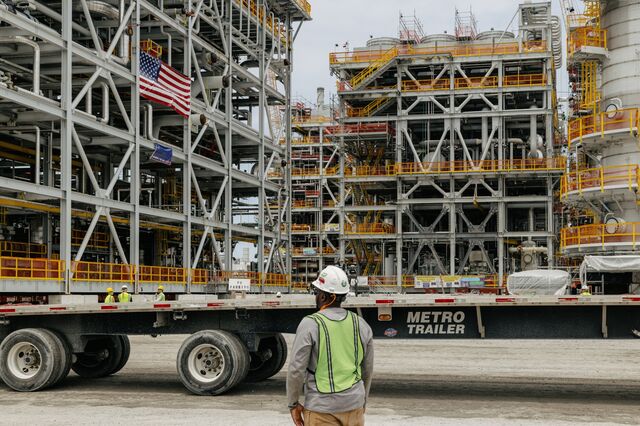
In some cases, the real work will take months — and maybe more — to execute, as federal agencies undertake a formal notice-and-comment rulemaking process to repeal and rewrite Biden-era regulations. Still, analysts and former Trump officials said they expect the changes to be felt immediately, potentially shaping boardroom decisions on auto product lines and drilling plans.
In finance, Trump set the tone for his deregulatory drive by promising to fire Wall Street’s top cop and end what he described as an “anti-crypto crusade” during the Biden era.
Securities and Exchange Commission Chair Gary Gensler has spearheaded a fierce crackdown on the crypto industry, which responded by throwing millions of dollars into presidential and congressional races. If Gensler follows Washington tradition, he will resign by inauguration day. The new SEC chief will likely support changes to existing securities laws to benefit crypto firms — or allow digital-asset companies to fall under compliance with rules on the books.
Other targets will likely include an SEC rule forcing companies to disclose their greenhouse gas emissions. That regulation was already watered down and considered vulnerable even before the election.
For powerful banks like JPMorgan Chase & Co., Goldman Sachs Group Inc. and Morgan Stanley, the biggest prize is the chance to further weaken and stall the Biden administration’s landmark bank-capital proposal. Trump can’t do that on his own but he can appoint sympathetic regulators who will.
What Bloomberg Intelligence Says:
High on the agenda is to remove the Biden administration’s moratorium on LNG export authorizations to countries without free-trade agreements, opening the way to granting permits and extensions for some of the proposed projects. We expect a couple of developers to reach positive final investment decisions in 2025 and move forward after no projects were greenlit this year, boosting US LNG exports by 2030. Other objectives could include energy infrastructure permitting reform to speed and simplify the convoluted process.
In finance, we’re likely to see at least a lengthy delay in the Basel III endgame, which would have increased capital requirements. That's already contributed to the rally in bank stocks.
In the cryptocurrency space, Trump will bring a friendlier SEC — easing enforcement risk as an immediate outcome for an industry that has spent hundreds of millions of dollars defending their position. His victory also increases the chances Congress will develop a comprehensive regulatory framework providing clarity for firms like Coinbase. We note however that such a framework will increase compliance and risk costs for crypto platforms, though the costs should be manageable for larger players.
Taxes
Behind the scenes, Trump’s policy advisers have been planning for what promises to be the economic Super Bowl of 2025 — the tax fight. Many of the provisions from the Republicans’ 2017 tax bill expire at the end of next year and Trump is looking to extend all of the personal income tax cuts as well as further reducing the corporate tax rate.
On the campaign trail, he also promised to rescind taxes on tips, overtime and Social Security checks — though it is less clear if he will be able to follow through, given concerns about the deficit. Out of all of those ideas, Trump is most attached to eliminating taxes on tips — a proposal he has spoken about since the Republican primaries after a Nevada waitress raised the idea with him. He has also talked about lifting the current cap on the state and local tax deduction, a key way he paid for the 2017 tax bill.
The bill for Trump’s tax wishlist totals $11 trillion and counting, according to the Tax Foundation. That includes the extension of the 2017 tax cuts, which will expire at the end of next year unless Congress acts.

Trump can’t do anything on taxes without Congress, which will result in an internal Republican battle over which ideas to prioritize and how big the bill should be. Adding to the complexities, a GOP trifecta in Washington would mean a flood of lobbyists pressuring lawmakers and the White House to tuck their pet tax breaks into the bill, potentially bloating and slowing down the negotiations.
If Democrats are able to notch a narrow victory in the House, the scope of the debate will largely be constrained to the items scheduled to sunset: lower individual tax rates, the child tax credit, the $10,000 limit on state and local tax deductions, a 20% write-off for many privately held businesses and a scaled back estate tax. Any deal would need to get a majority in a Democratic-led House and 60 votes in the Senate, necessitating bipartisan compromise.
The possibilities for tax cuts explode if Republicans hang onto their House majority. That would allow them to use a legislative procedure to usher a bill through both chambers solely on GOP support.
What Bloomberg Economics Says:
Even though it’s likely Republicans will control Congress, we think Trump’s most sweeping tax-cut proposals won’t be fully realized. The cost in lost revenue would run into trillions of dollars, and there's no viable plan for plugging the gap. Bond vigilantes are already driving up Treasury borrowing costs. We think market forces will provide a check on Trump’s plan. Considering what’s plausible, we estimate that Trump's tax policies will mean modestly faster growth and higher inflation, and put debt on a path to 141% of GDP by 2034, compared to a no-policy-change baseline of 134%. This assumes most but not all of the individual tax cuts in the 2017 Tax Cuts and Jobs Act will be extended, and Social Security and tips won't be exempted from income tax. If Trump delivers everything he promised, the debt ratio would rise to 150% of GDP in 2034.
Trump Tax Policies Would Mean Faster-Rising Debt
Forecasts for US debt as share of GDP under various scenarios