

11 Startups Leading the $1.8 Trillion Climate Tech Revolution
These companies have won BloombergNEF’s annual Pioneers competition for the most promising climate tech.
The 2020s are a pivotal decade that will show how serious the world is about stemming global warming.
It might seem like the fight is losing steam, given furious backlash from multiple quarters, including investors, farmers and drivers. Yet, a record $1.8 trillion flowed into green technologies last year, helping to grow a generation of startups seeking to cool the planet. That innovation is what underpins BloombergNEF’s annual Pioneers competition, which identifies some of the most promising companies rising to meet the climate challenge.
In the world these startups are trying to build, clean energy rushes through state-of-the-art wires. Jets run on emissions-free fuel created from plants. Apartments tap the Earth to stay both cool and warm.
But, of course, it’s not that simple. It’s far from clear whether these solutions will get the support they need to reach escape velocity and transform our economies.
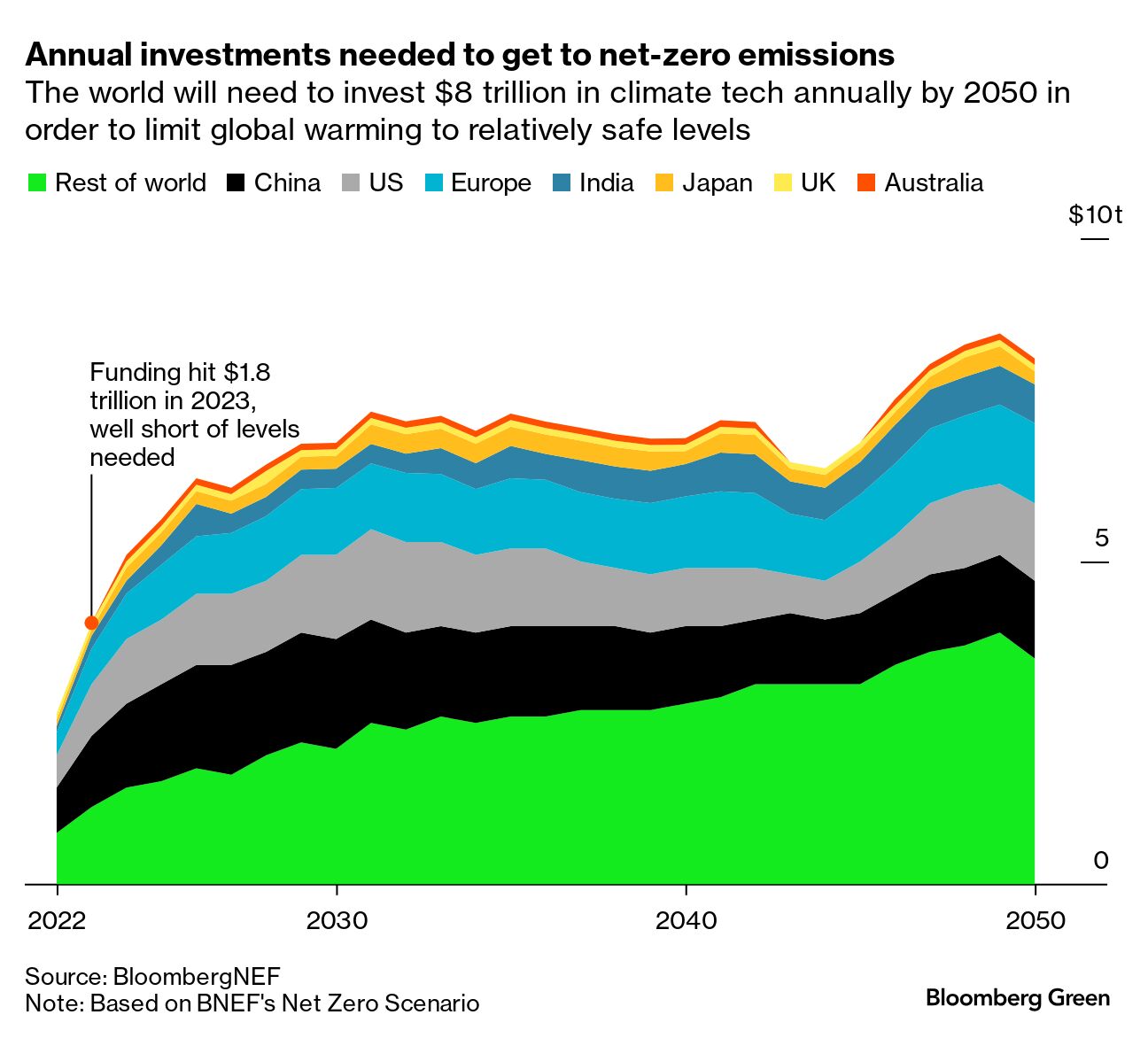
Annual investments needed to get to net-zero emissions
The world will need to invest $8 trillion in climate tech annually by 2050 in order to limit global warming to relatively safe levels
In 2024, half the planet’s population will go to the polls. No election may have a bigger impact on the climate than the US, where former President Donald Trump has promised to gut most of the nation’s biggest climate law if he wins.
Voters in India, the world’s largest democracy and a growing power player at global climate talks, will also have their say. So will citizens in five Latin American countries, including Mexico, where climate scientist Claudia Sheinbaum could win the presidency. In Europe, right-wing politicians are poised to take a bigger chunk of the seats in the European Parliament.
Permits and regulations are two other major potential bottlenecks to deploying more clean energy. Officials are facing a huge backlog of applications, particularly around adding new transmission lines and upgrading existing ones. Without a faster process, projects could languish, prolonging the life of fossil-fuel infrastructure.
Perhaps the biggest hurdle is demand. While clean energy now costs the same as, or less than, fossil fuels, other pieces of the decarbonization puzzle still come with a “green premium.” The question remains: Who will buy more costly technology and materials, and how much are they willing to pay?
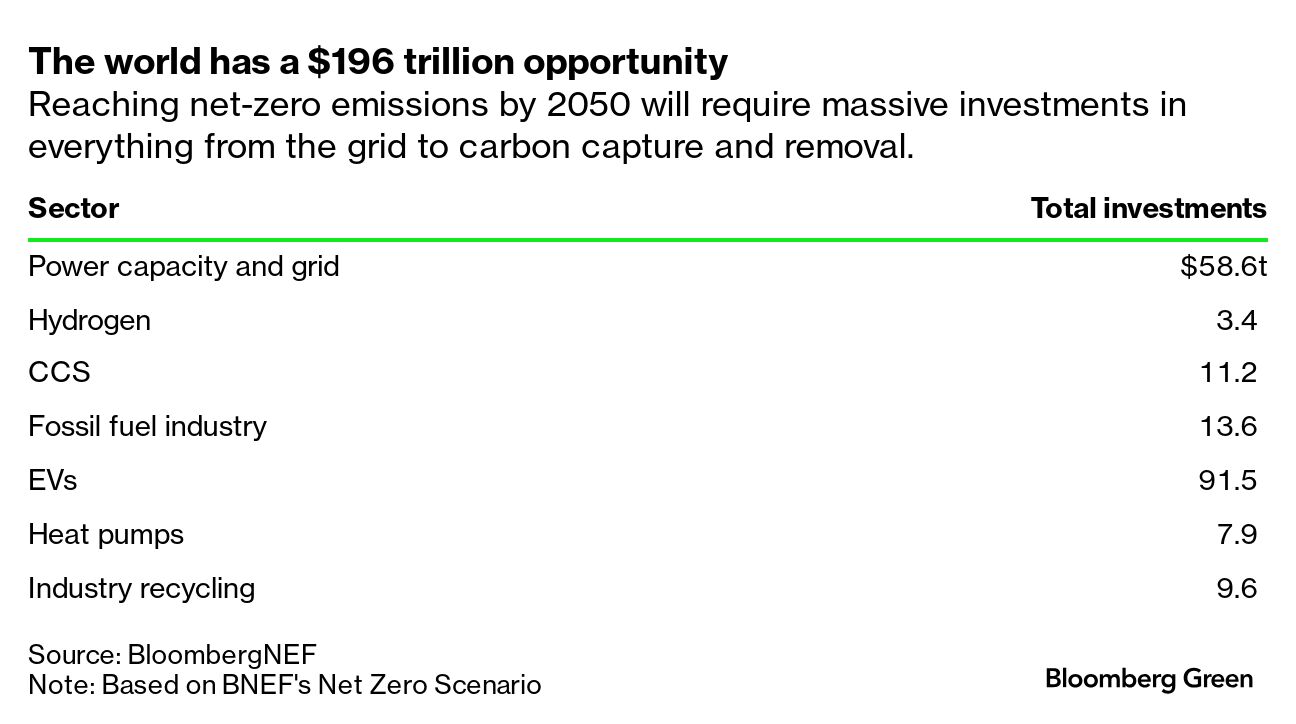
The world has a $196 trillion opportunity
Reaching net-zero emissions by 2050 will require massive investments in everything from the grid to carbon capture and removal.
“I think it's easy to say, ‘let's throw subsidies and tax credits at things,’” said Claire Curry, the strategic lead of BNEF’s technology and innovation research. But it’s not always that easy to just “drop in” a greener replacement, she said, if there isn’t enough demand to drive the change.
BNEF identified three key challenges for this year’s Pioneers: getting clean power on the grid faster, lowering buildings’ carbon footprints, and developing low-carbon fuels. It also awarded three startups in its “wildcard” category. The 11 winners were selected from 240 applications and voted on by a group that included Bloomberg Green editors.
Challenge 1 Relieving clean-power bottlenecks
At last year’s global climate talks in Dubai, governments set a goal to triple renewable energy by the end of this decade. Building solar and wind is cheaper than ever, but other bottlenecks could put that target in danger.
For example, it can take up to seven years in the UK for a wind or solar farm to come online after its been permitted, according to Mark Daly, head of technology and innovation at BNEF. Changing regulations is one way to cut down that time. Technology, though, can help developers speed up grid feasibility studies and find the best sites for projects.
The grid will also need an overhaul. BNEF forecasts investments will need to rise to $777 billion in 2030 to better transmit clean energy and distribute it more efficiently. Crucially, developers and utilities need new software to deal with peaks and troughs in renewable generation and manage battery storage.

Challenge 2 Decarbonizing buildings
Buildings are where we spend most of our time, and the sector is responsible for an eye-popping 37% of the world’s greenhouse gas emissions, according to the United Nations.
That includes the construction of new buildings, which relies on carbon-intensive materials like steel and cement, and extra energy needed for heating, cooling and lighting. Then there are the properties that have been around for decades, which are essentially leaking carbon dioxide daily due to issues like inefficient HVAC systems and subpar insulation.
Startups are working to find more climate-friendly ways to build. Retrofitting homes and offices — and ensuring the carbon embodied in the construction materials stay locked up — is another important way to reduce emissions. And these solutions also come with an added bonus: They often result in living and working spaces that are more comfortable.

Challenge 3 Creating new net-zero fuels
While the electric vehicle transition is well underway (albeit not fast enough) for passenger cars, other forms of transportation are still struggling to find solutions.
Aviation, shipping and long-distance trucking are all hard to electrify because batteries are heavy and can’t hold all the energy these industries need. Planes, which account for more than 2% of global emissions, are the hardest to clean up. The industry’s share of emissions is set to rise in the coming decades as more people are able to afford air travel and other sectors with readily available alternatives cut carbon.
That puts the focus on alternative fuels that are dense in energy but don’t pollute the climate. “We’ll need fuels: better fuels and not fossil fuels,” said BNEF’s Daly.
The world has a plethora of options. Biomass and food waste are already used to make clean jet fuel. But that accounts for a tiny portion of aviation fuel used today. Methanol holds promise for shipping and green hydrogen could power trucks. Meanwhile, e-fuels made from carbon dioxide could be the best option in terms of emissions. From barely nothing today, the e-fuel market could reach nearly $50 billion by the end of this decade, according to some industry estimates.
Yet all are expensive, energy-intensive and far from commercialization. The winners of this challenge have unique solutions that could help overcome those barriers.

Wildcards
Perhaps the most interesting thing about the wildcard winners is how little they have in common. That shows how carbon cuts will have to come from every corner of the economy.
Still, the winners intersect with the other three challenges, whether it’s producing clean steel for buildings or improving lithium-ion batteries so they can better serve the grid. Looking for signs of biodiversity could help with, among other things, siting renewable installations. They’re startups that are, according to BNEF analyst Stephanie Diaz, “trying to prevent a bottleneck before it occurs.”
Updates to include estimate of e-fuel market in creating cleaner fuels section. A previous version was corrected to remove first reference of iron ore in Element Zero description.