India’s Flooded Farmlands Mask a Water Crisis Deep Underground
No other country consumes more groundwater. That’s testing India’s ability to feed itself and much of the world.
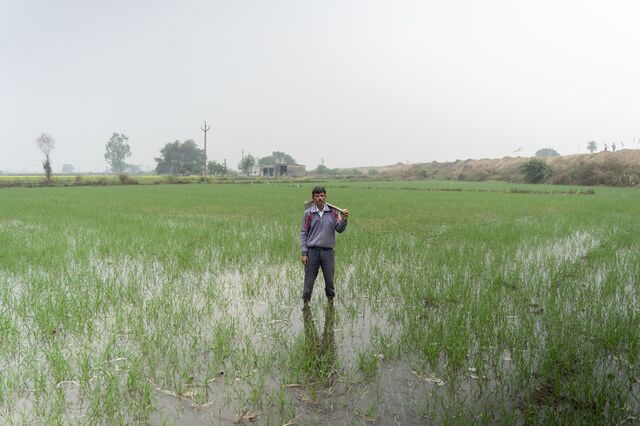
It was shortly after dawn when Zila Singh tended to his wheat crop in northern India late last month, the winter sun slowly creeping above the horizon.
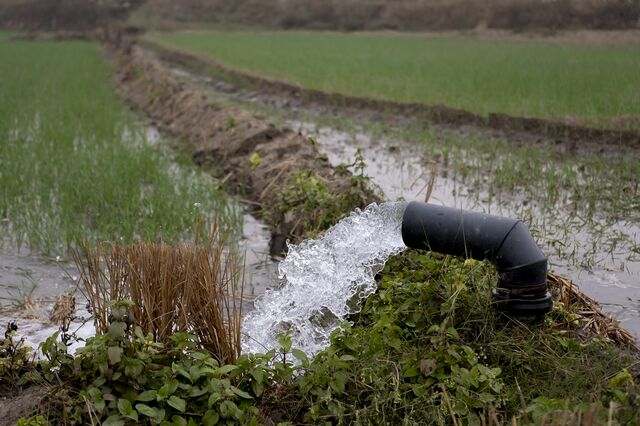
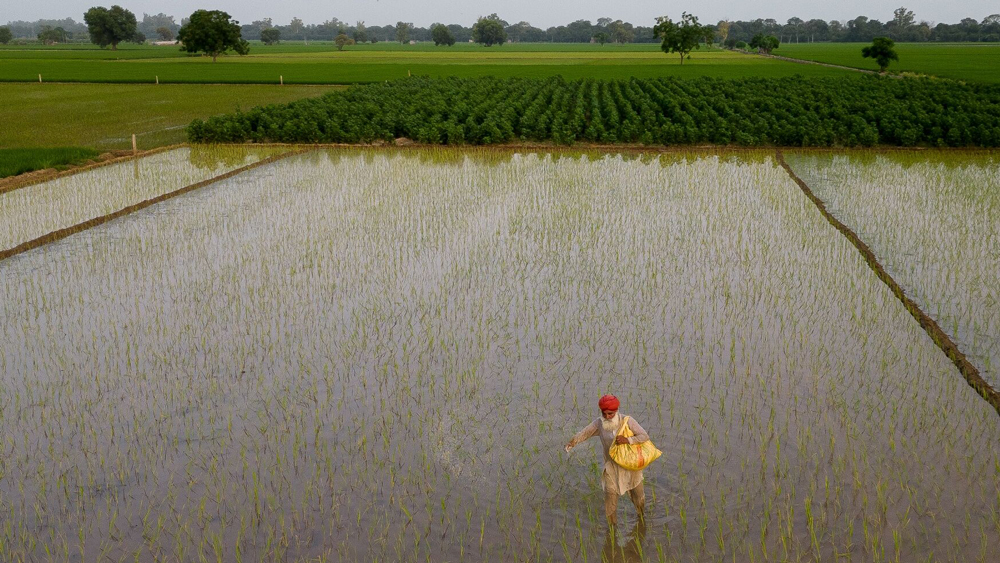
Clutching a hoe in calloused hands, he trudged across fields flooded with water brought from deep below the surface, just as it has been every sowing season for decades. Unable to tap the polluted flows of nearby canals, Singh, 48, pumps groundwater instead. In one of the most parched corners of the country, the water sloshes from large pipes at the corners of his plot.
Flood irrigation, a method in which fields are soaked to nourish the soil, is wasteful and inefficient, but often favored by farmers as inexpensive, low-tech and time-tested. Extracting water using a pump powered by subsidized electricity costs Singh as little as 240 rupees (about $3) a month.
Used by millions of rice and wheat farmers in breadbasket states, the practice is emblematic of the unchecked overuse of resources damaging India’s future agricultural prospects — in this case by quietly draining invisible underground reserves that the country needs to feed itself and much of the world for decades to come.
The South Asian nation is already the world’s largest guzzler of groundwater. Cheap power has encouraged routine overreliance on finite riches. India overwhelmingly grows some of the thirstiest crops: rice, wheat and sugar cane. Over the last half century, farm productivity has leapt forward, but so, too, has water usage — up 500% over that period, according to the World Bank.

Erratic monsoons and brutal heat waves are only making the problem more acute. Farmers are digging deeper wells because existing ones are no longer refilling. Some regions may run out of groundwater entirely — Punjab, a major wheat producer, could go dry within the next 15 or so years, according to a former state official. States in southern India are battling over water rights in areas where rampant urban development has drained thousands of lakes.
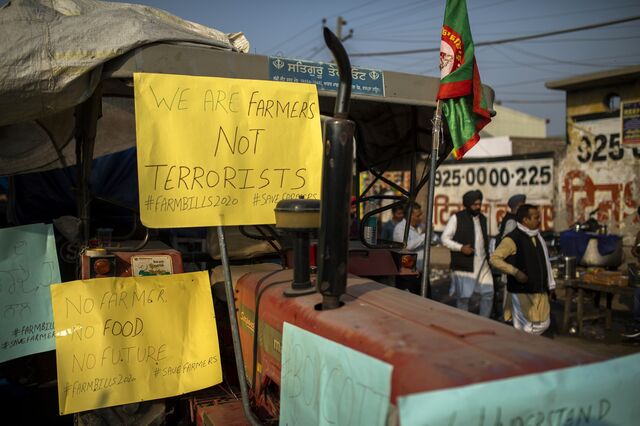
The government is not blind to the crisis. But with a national election on the horizon next year, there’s little to gain in pushing actively for change among farmers, one of the most important voting blocs in the country. Any long-term solution will involve tinkering with farm subsidies or the minimum price set for water-intensive crops. Prime Minister Narendra Modi’s ruling party is all too aware that farmers from India’s grain-growing northern regions dominated months of protests against proposed agrarian reforms from late 2020.
Modi was forced to withdraw the proposals.
World's Top Water Consumers
India withdraws more than the US and China combined
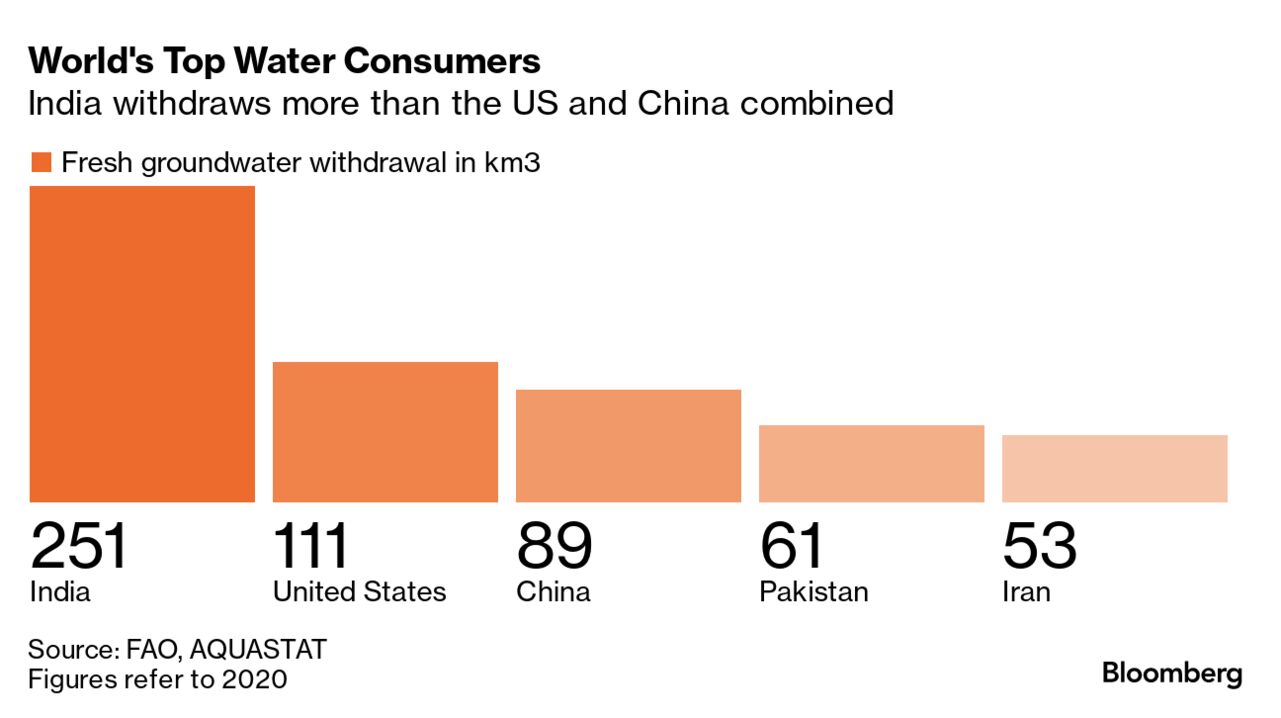
For now, it’s clear the water math does not add up.
Modi has promised piped water to all Indian households by 2024. Yet nearly half of India’s 1.4 billion residents already face high-to-extreme water stress, and the world’s most populous nation is expected to add more than 200 million more people by 2050.
Agriculture, meanwhile, accounts for 90% of water use, helping to explain why Indian officials say the clearest strategy for preserving supplies is modernizing the industry. The government has tried to convince farmers to adopt different irrigation technologies, return to traditional rain harvesting and plant less thirsty crops like millets, pulses and oilseeds. Nothing has yet made a substantial difference, in a country where subsidies supporting wheat and rice persist, and farming is dominated by smallholders.
For Singh, the farmer in the water-logged field, the government must find better ways to encourage cultivators — and protect their livelihoods — if it wants to implement ambitious reforms. Incentives are key.
“We get guaranteed prices for rice and wheat,” he said. “Traders and commission agents are hand-in-hand buying other crops from us. They always undercut our prices.”
Debashree Mukherjee, secretary of India’s water resources department, didn’t reply to requests for comment.
The system that jeopardizes India’s future is also the one that saved it from a precarious past.
After India achieved independence from the British in 1947, the government faced a daunting problem: how to feed hundreds of millions of starving people. During the Bengal famine, as many as three million Indians died.
By the 1960s, India was well on its way to finding a solution. Overseen by pioneering agronomist M.S. Swaminathan, a green revolution converted the country from a food-deficient economy to a leader in agricultural exports. One major success was developing high-yielding grains — particularly wheat and rice varieties — that responded swiftly to fertilizer and resisted disease. Irrigation helped incomes.
But methods from the green revolution have aged poorly.
Before passing away this year, Swaminathan warned that India’s ability to feed itself was increasingly threatened by global warming and unsustainable farming practices, with a continued reliance on water-intensive crops popularized in the 1960s.
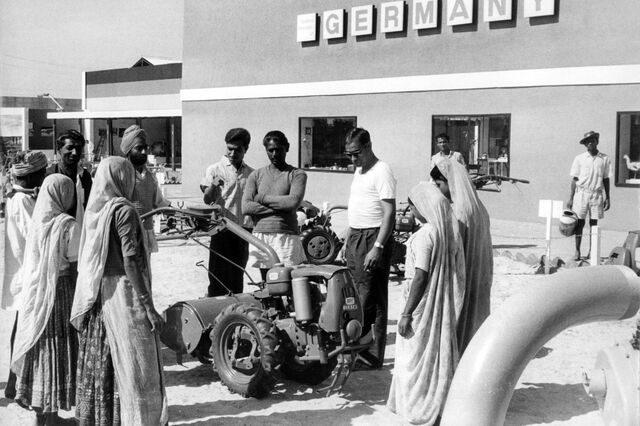
Even after huge population increases over the past few decades, farmers face few restrictions on water extraction. Coupled with massively discounted electricity to run the pumps, cultivators continue to dig deeper borewells. Today, about 74% of the area used for wheat cultivation and 65% used for rice face significant water scarcity — with the breadbasket states all increasingly parched.
Veena Srinivasan, a water management expert based in Bengaluru, likened the government’s subsidies to distributing a small amount of Halloween candy to a large group of children and then expecting restraint.
“Nobody’s saying, ‘It’s a fixed pie. There’s only so much of it,’” said Srinivasan, executive director of the Water, Environment, Land and Livelihoods Labs.
“There’s no sharing,” she added. “We’re just terrible at that.”
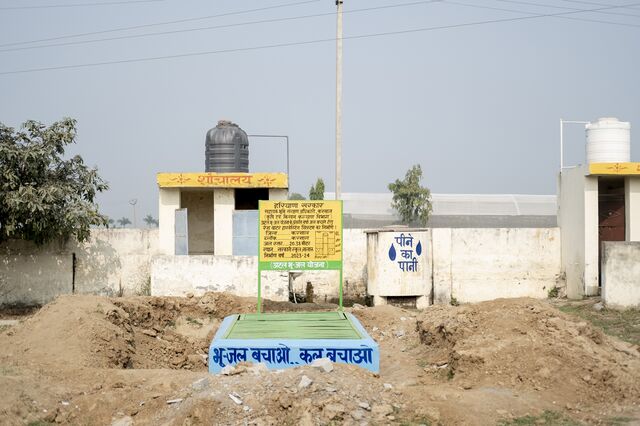
A short drive from Zila Singh’s farm, officials are searching for solutions. Known as one of India’s largest grain-growing regions, Karnal district, in the state of Haryana, is speckled with murals in Hindi and English promoting the uptake of millets and urging residents to “Save Water, Save Tomorrow.”
The success of these campaigns depends on people like Wazir Singh, the bushy eyebrowed deputy director of Haryana’s Agriculture and Farmers Welfare Department.
To combat unsustainable water use, he dispatches officers to the surrounding fields, where his deputies educate farmers about water conservation, crop diversification and soil treatment.
“It takes time to convince farmers,” he said in an interview from his office. “They usually consider immediate profit from their crops.”
A study released in September found that farmers are only increasing their reliance on groundwater to cope with warmer temperatures. Within the next 20 years, the rate of depletion may triple from its current level.
India Uses More Groundwater than Any Other Nation on Earth
Despite national-level improvements in recent years, resources in Punjab, Haryana and Rajasthan remain over-exploited.

One of the clearest — but potentially contentious — ways to encourage change is to tackle subsidies, starting with reducing the availability of cut-price electricity, which benefits a large number of farmers, according to Meha Jain, an associate professor at the University of Michigan who studies agriculture. This step, along with prioritizing less thirsty crops, could push farmers toward more efficient irrigation systems like sprinklers and drip pipes.
“These changes will have to be done in a way that does not harm farmers’ profits,” Jain said.
The federal government has also encouraged rainwater harvesting across the country through a program called “Catch the Rain,” along with repairing water tanks and recharging borewells.
The government in Haryana, a major agricultural producer and one of the most water-stressed states, is moving carefully.
Officials pay farmers 7,000 rupees per acre if they plant crops that consume less water than rice. For those unwilling to make the change, they can still claim 4,000 rupees an acre if they directly seed their rice — rather than the traditional method of growing seedlings in a nursery and then transplanting them to flooded fields.
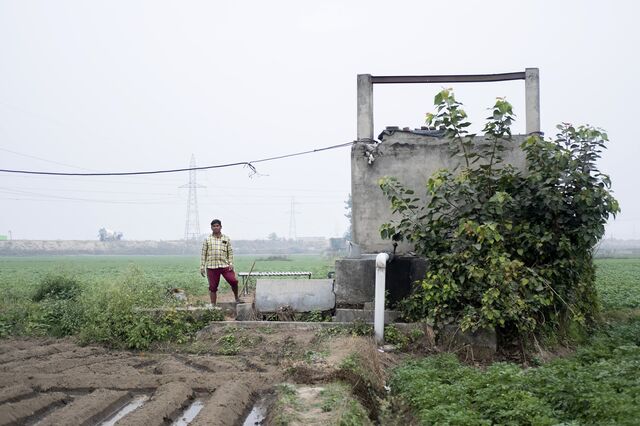
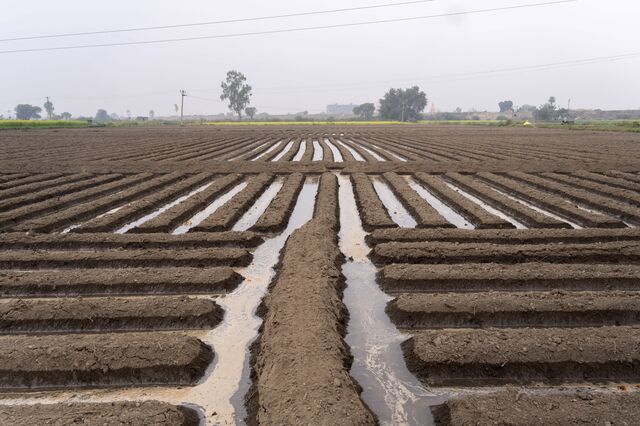
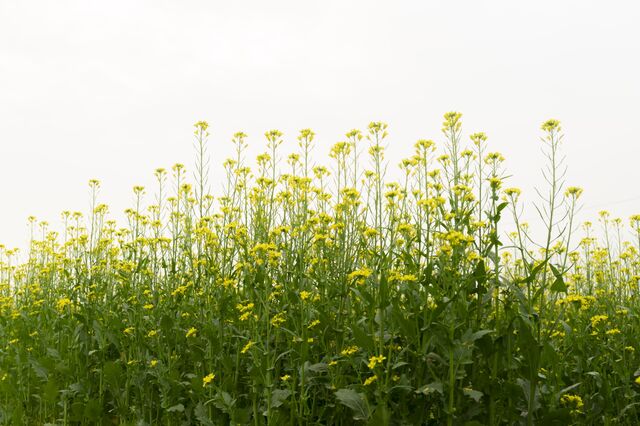
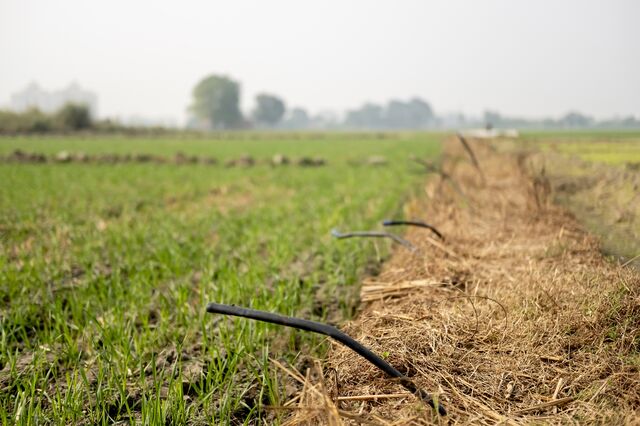
One farmer who’s taken the plunge is Zila Singh’s neighbor. Past potato fields and rows of bright yellow rapeseed, Inder Kashyap directed a handful of workers on a recent morning, traversing the 35 acres of land he uses to grow rice, wheat, corn and flowers.
Kashyap’s story is typical of this region. His family took up farming in the 1970s during the green revolution. Kashyap, 44, learned how to irrigate the farm exactly as his father had — drawing up ground water from the earth. In his district, the water table has fallen nearly 3.5 meters, or about 11 feet, over the past decade.
But a couple of years ago, Kashyap made what many peers considered a radical switch. He decided to take up the state government’s cash offer in exchange for less wasteful cultivation.
At first, Kashyap started directly seeding some of his rice paddy, piloting it across two acres. He discovered that the grain matured quicker and he saved labor costs because planting also went faster. Next year, he plans to grow rice this away across the entire farm.
“It consumes less water and the yield is either the same or a little higher,” Kashyap said.
On paper, the government’s policies are strong, said Chandni Singh, a senior researcher at the Indian Institute for Human Settlements in Bengaluru, who has studied water issues. But many of India’s poorest farmers still have limited access to the formal economy, so handouts from the government only go so far.
“They are often people who don’t have the right networks to get that money,” she said. “All those challenges remain.”
Even those with more resources are often stymied by mismanagement and poor upkeep of equipment and infrastructure.
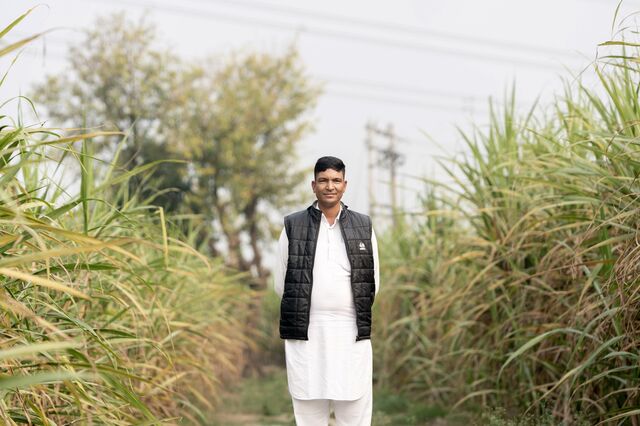
An hour’s drive from Kashyap’s plot, Ramdev Tanwar, who grows rice, wheat and sugar cane, installed an extensive drip-feed water system this year on his 65-acre farm. It was mostly free of charge thanks to a state government initiative.
But when the water didn’t flow, Tanwar clashed with a contractor who said he wouldn’t fix the problem unless the farmer paid him some money and a tax. Nine months later, Tanwar hasn’t resolved the dispute and he’s still irrigating his crops with ground water.
“My friends and neighbors are making fun of me,” he said, walking through one of his sugar cane fields.
On a recent day, Kuldeep Sharma, an assistant sugar cane development officer for a nearby town, inspected Tanwar’s irrigation system. He blamed another government department for failing to fix the issue.
“Farmers have herd mentality,” said Sharma, as he studied the piping. “Thanks to this they will hesitate to go for drip irrigation.”
Unlike rice and wheat, which the government buys at a minimum price, grains like millets, oilseeds and pulses aren’t yet attractive crops for many farmers. Though some price protections are in place, the government doesn’t buy millets in huge quantities, for instance, and demand is still low in India.
“It’s all very well to tell people to grow dry land crops, but everybody wants to eat rice,” said Srinivasan. “It’s not easy to go and change the eating habits of a population overnight. You have to create a market.”
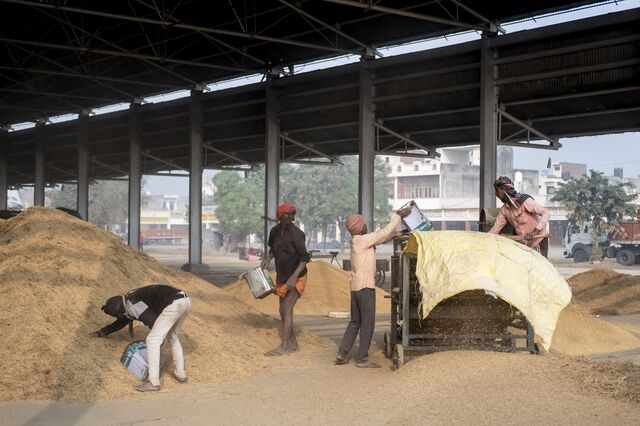
That sentiment echoed through Karnal’s massive state-controlled grain market on a recent afternoon. As laborers filled sacks with rice and loaded them onto trucks, a cluster of farmers from Haryana and Uttar Pradesh scoffed at the idea of cultivating food that saves water but doesn’t come with price protections.
Balinder Kumar, 48, who was selling his rice at the market, said fears of over-depletion were exaggerated. “There are no worries,” he said. “God will take care of the ground water situation.”
But tensions have already reached a breaking point in some parts of the country. Farmers protested this year after severe droughts in southern India. Lawsuits have also been filed in the states of Karnataka and Tamil Nadu over access to water from a shared river.
Poor water management is exacerbating the financial strain on India’s farmers, already indebted and under strain as rains become erratic. More are taking high interest loans to dig wells after existing ones dry up.
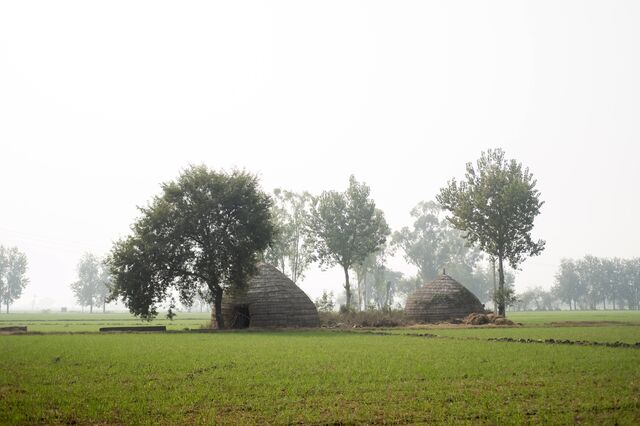
Moving through his fields, Zila Singh said he hopes his 16-year-old son will one day take over the land, though he conceded that the future seems bleaker for the younger generation.
Lately, he’s looked on with interest as Kashyap and other neighbors experiment with new technologies. But for now, at least, changing lifelong practices won’t happen overnight.
“I will shift gradually,” he said with a wry smile.
Sign up for the India Edition newsletter by Menaka Doshi — an insider’s guide to the emerging economic powerhouse, and the billionaires and businesses behind its rise, delivered weekly.