Bloomberg Businessweek
The Electorate: America Divided
- The Data
- Partisan Ohio
- Middle Class
- Job Lovers
- Mark Cuban
- Old People
- American Frights
- Gun-Rights
- Counterculture
- Modern Church
- Drake Lessons
- Childcare
- Graduate Salaries
- Rural American Dream
- What’s at Stake?
- Population Growth
- Refugee Haven
- American-Made*
- Alt-Right
- The Anger Won't End
- America’s Divisions Are a Cause for Hope
Gun-Rights Advocates Explain Their Cause—and Their Game Plan
“If I vote for Hillary, I’m voting to kill the Second Amendment.”
By Paul M. Barrett
September 15, 2016
Chuck Michel, 58, Long Beach, Calif., gun-rights lawyer
You file lawsuits to protect people’s Second Amendment rights, and your most recent one in California seeks to establish a right to “bear arms” publicly for self-defense. Why is that?
We sued about seven years ago in the Peruta case in San Diego, because the sheriff there wasn’t giving out gun-carry permits unless you had “good cause.” [That case led to a defeat of the pro-gun side in the federal appeals court in San Francisco. The court gave local law enforcement officials broad leeway to deny concealed-carry licenses.] At roughly the same time, the state of California effectively eliminated by statute the ability to open-carry in response to these guys going into Starbucks and scaring people when they walked into the stores with open-carry firearms. Our new lawsuit in the Flanagan case says you can’t ban both open and concealed carry. You have to allow one manner of carry or the other. That’s how you allow people to “bear arms.”
How many suits like Flanagan are filed around the country each year?
[In recent years] there were probably a couple hundred lawsuits filed, 50 of them by the top Second Amendment players. I’m just on the team; there’s a lot of other lawyers across the country working at the top levels.
After the 2008 Heller decision by the Supreme Court [establishing an individual right to keep a gun in the home], there were a ton of Second Amendment lawsuits filed. Unfortunately, a lot of them were filed by unqualified, inexperienced, underfunded lawyers. They thought they could staple the Heller decision to their complaint and mail it in. And then there were the more sophisticated, higher-level lawyers who worked for either the National Rifle Association or the Second Amendment Foundation, who filed some suits with much more strategy behind them. But even the more skillfully crafted suits haven’t had much success, because of the hostility of most lower courts—or at least the majority of judges on most lower courts.
Do you do the Second Amendment cases pro bono?
The NRA and California Rifle & Pistol Association are clients. The volume is way too high for us to do it pro bono. I do it at a greatly reduced rate, nowhere near our commercial rates. We still do OK.
If you win the Flanagan case, will you carry a gun in public?
Carrying a gun around is literally a pain in the ass. It’s like carrying a baseball around. It’s not your wallet. It doesn’t slip easily in your back pocket. It’s one thing if you’re a woman with a purse, maybe. A lot of people say, “If I’m going into someplace dangerous, then I’ll bring it. Otherwise, I’ll leave it in the car.” That’s sort of the way the habits break out, it seems, once somebody gets a permit. You don’t bring it into the courthouse, because it’s prohibited there. Like at a business meeting, I don’t think I’m going to be carrying. I would probably leave it locked in my car.
And your vote for president?
I can’t vote for Hillary. If I vote for Hillary, I’m voting to kill the Second Amendment. It’s coming down to who’s going to put those next few justices on the Supreme Court. Trump, with all his warts, is your only choice if you want you and your children to have a right to own a gun.
Steve Sanetti, 67, president of the National Shooting Sports Foundation, the trade association for the gun and ammunition industries
How does the National Shooting Sports Foundation differ from the NRA?
The NSSF represents the business side of things. The NRA is a consumer membership-based organization. Often we are in parallel with each other, but there are times when we defer to the NRA, others when they defer to us.
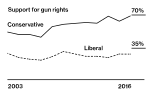
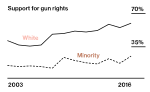
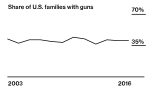
The Pew Research Center has some fresh polling numbers—46 percent of the general public say it’s more important to control gun ownership, and 52 percent say it’s more important to protect gun rights. In 2000, 66 percent were for more gun control vs. only 29 percent for protecting gun rights. What explains the shift?
More women are buying firearms. More people from diverse ethnic and cultural backgrounds are buying firearms.Obviously if one owns a firearm, one is less likely to say that their right should be infringed somehow.
Why don’t we hear more from pro-gun Democrats such as retired Representative John Dingell of Michigan?
I guess you can tie that directly to the demise of the so-called Blue Dog Democrats. Conservative Democrats from the South, Midwest, and rural areas traditionally have been strong supporters of firearm ownership. Unfortunately, conservative Democrats and those who were in favor of the outdoors tradition tend to be a shrinking minority within their own party. Lines are becoming more sharply drawn.
What is #GUNVOTE?
#GUNVOTE is the NSSF’s voter education program.
Is #GUNVOTE coordinated in any way with the NRA, which is spending millions to oppose certain candidates?
No, totally independent.
By unhappy coincidence, your offices are in Newtown, Conn., not far from the scene of the December 2012 Sandy Hook Elementary School shooting massacre. What lessons can we take from that horrible event?
The main lesson that we have taken from that horrible, horrible incident is one that we tried to impress on the Newtown community within two weeks of the shooting and were rebuffed for our efforts. They talk about “Let’s never have this happen again.” They talk about things like background checks. Mrs. [Nancy] Lanza, the shooter’s mother and the source of the guns he used, passed five background checks, one to obtain each of her guns. They talk about gun shows. She didn’t buy any guns at a gun show. What we said was, had she, as a responsible gun owner, kept those firearms securely away from her son, whom she knew to be at risk, maybe this thing would not have occurred.
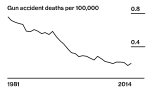
We have a 15-year effort, Project ChildSafe, designed to have owners unload and lock their guns securely away from children, careless adults, people who are mentally disturbed, and other unauthorized individuals. Project ChildSafe has given away over 37 million free gun locks. We are the ones doing effective gun safety programs, not the gun-control advocates. The lesson of Newtown is, let’s do things that work to help prevent these things from happening again, not just things that make good sound bites or things that might be politically palatable to advance somebody’s agenda.