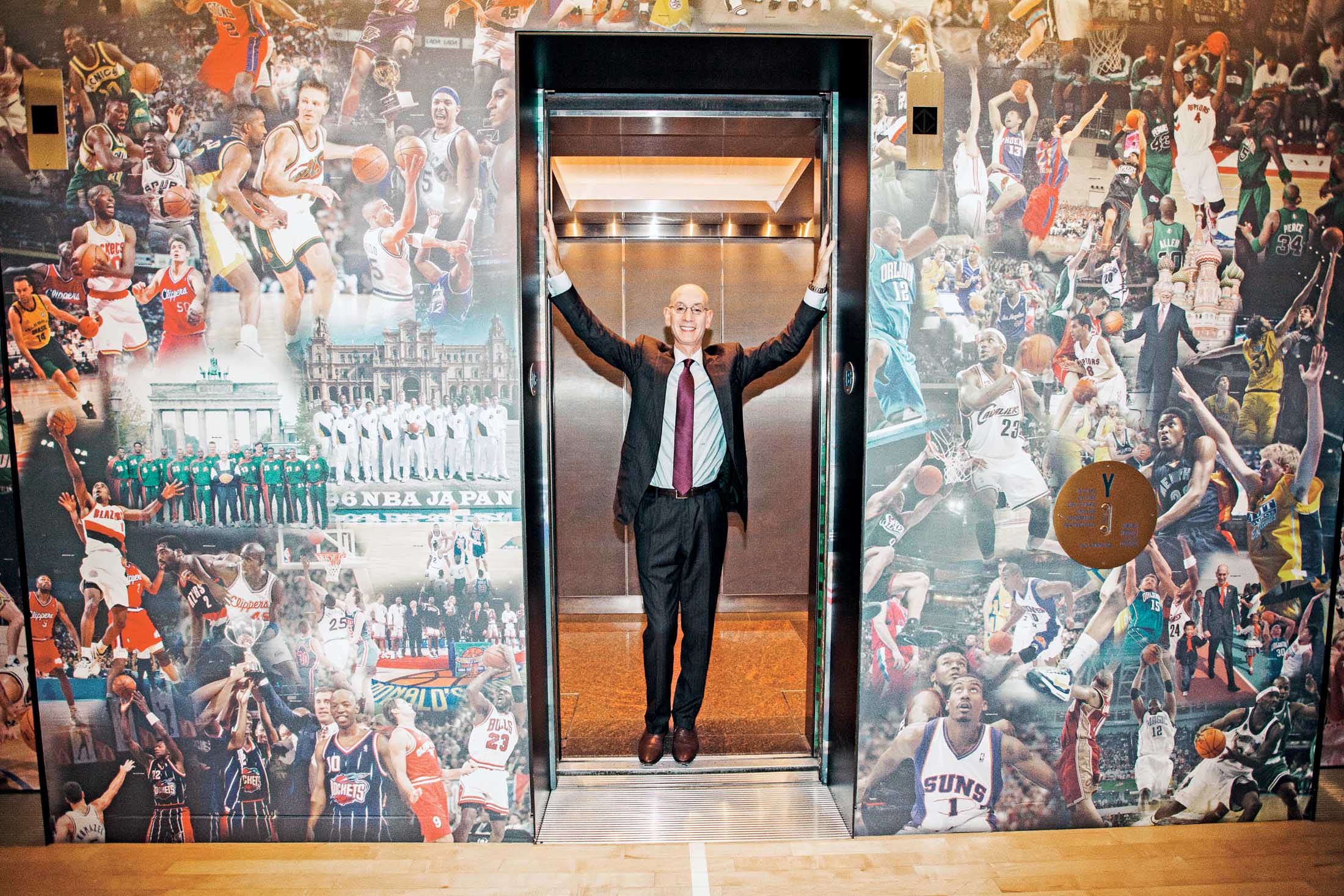
NBA Chief Adam Silver Isn’t Expecting Another Lockout in 2017
From 
The following is a condensed and edited interview with Adam Silver, commissioner, National Basketball Association.
I’m going to abuse my privilege here to lodge a complaint, which is that basketball is a great flow sport, but NBA games stop too much. If it were me, I’d try to take most of the timeouts away from coaches. I know you have to have them for commercials and for rest, but if they were just programmed in, maybe longer and fewer—
It’s so interesting: I thought you were going to say the opposite. I think coaches should have timeouts, because it’s something they tactically need. The truth is, we try to find the right balance. Of course, we have to ensure that we get our commercials in. At the same time, it is a game of flow. And one of the things that the competition committee is meeting on this summer is, what can we do to enhance flow, particularly in the last two minutes of the game. Should we be reducing the number of timeouts in the last two minutes, the length of timeouts in the game? My sense is, there’s a general agreement that we should do something. Figuring out exactly what we should do isn’t easy.
Will you be back at the collective-bargaining table next year?
Well, we’re back at the table already. While we and the union have agreed that we’re not going to talk publicly about the substance of our discussions, neither side has made it a secret that we’re talking and that the goal is, of course, to avoid any type of work stoppage whatsoever. I feel fairly confident that, based on the tone of these discussions thus far, based on the sense of trust and the amount of respect among the parties, that we should be able to avoid any kind of public labor issue and that the things we need to get done will get done behind closed doors.
The executive director of the players’ union, Michele Roberts, gave an interview where she called salary caps un-American. What is your relationship with her like?
The communication is very direct between Michele and me. As a still relatively new head of the union, I think she is establishing herself, and it’s not for me to say what she should be saying publicly or otherwise. What I care most about is what is said across the bargaining table. We have built a relationship. We’re in the process of growing that relationship. I have tremendous respect for her. She has never made any issues personal. And to the extent she’s said things publicly, I think she’s made a distinction between what may be a personal point of view and a position that the union is taking.
Early on, you talked about one of your top priorities being moving the minimum age for players up from 19 to 20 years old. Is that still something you want?
It’s still something I care a lot about. I’m also a realist. Given that Michele has said her preference would be for an 18-year-old minimum age, my sense is that it’s not something that’s going to change in the short term. And by the way, I’ve always said I understand the other side of the issue, about a young man’s opportunity to make a living. But my view has always been that we’d be a better league if players came into the draft at 20 instead of 19.
Overall revenue for the league will be about $8 billion this coming season. The new TV deals with ABC/ESPN and TNT bring in, on average, about $2.7 billion a year. Is that sustainable? And when those deals come up again in 2025, do you think they’ll still be your biggest single revenue stream?
I am not confident predicting on what platform our viewers will watch our games. What that will look like in 2025 is somewhat unpredictable. But I think media will remain our single-largest stream of business. In part, that’s the reason that we went fairly long on our current television relationship. At the same time, we have a relationship with Tencent in China, which represents in many ways the next generation of television, where they’re streaming 600 games. There’s an enormous amount of competition right now among these various services. We’re partnering with Twitter in the U.S. now, with their burgeoning live-streaming service. My sense is that 10 years from now, whatever platform we’ll be on, the fundamental game experience will be different. There will be an enormous amount of interactivity that doesn’t exist now, which will lead to further engagement, meaning more minutes spent watching the telecast. So I welcome the change.
You think it can be as lucrative?
I think it will be more lucrative. We have a current model that’s based on prime time as the primary window to watch television. The challenge always for us has been that, in many territories, our games aren’t on in prime time. Games on the East Coast, for example, are on at drive time in China. And so you have tens of millions of commuters who are interested in watching the NBA. And now it’s no further than the television in their pocket. That same change in viewing patterns is going to be critically important for Africa, a market we’re very focused on, and for India. Ultimately, it may make sense for us to play some of our games outside of prime time or weekend afternoons in the United States.
What did you learn from the a la carte, single-game streaming that you offered for the first time this past season for out-of-market games?
We learned that it was incredibly popular. Largely, the reason we sold it as an all-you-can-eat package historically was it was a limitation of technology. Frankly, it still is, on a lot of cable systems. But for smartphones and tablets, where a lot of the consuming is taking place for our broadband League Pass [out-of-market TV subscription service], consumers were telling us that it didn’t seem like a great proposition to pay one price for 1,200 games. It’s great value if you watch a lot of games, but other fans love the idea that they can buy a single game just as they would a movie. It encourages more sampling.
It also allows us to send people on social media directly to games. So, for example, if you’re on Twitter: You’re following somebody’s feed, and you read that Kevin Durant is going for 50 points and the game is 7 minutes into the second quarter—it’s click, and for roughly $7, you’re now watching the game. I think as we get even more sophisticated, it may go beyond single games. It may be there’s two minutes left in the game, and it’s a tie game, and there’s an alert. Consumers may want to watch the last two minutes. I’m sure some algorithm will spit out a price that’s appropriate.
Are there changes in your tenure, that you already consider mistakes? Maybe the short-lived team format for the dunk contest at the All-Star Game in 2014?
That’s a great example. There was enormous confusion not just with the fans in the arena, but I think the players were a bit confused. One of the things I’ve learned in business is, don’t overly complicate things. And there are no shortcuts for introducing new processes. Often, you should find ways to introduce them outside the glare of the big lights.
How often do you get to actually watch games once the season’s under way?
I can’t think of a night where I’m not watching some portion of a game. I watch highlights every single night. There’s almost always something interesting to me about every game, a particular player I’m interested in, a coach who’s trying something new, a matchup where there’s some particular fascination. I love watching the game. I have the benefit of our national broadcasters on ABC, ESPN, and TNT and hearing the different perspectives they bring to the game. Many of them, former players, former coaches, share ideas about things they would change. I’ll be watching a game with my wife, and the announcer says, “If I were Adam Silver I would … .” And I always sit up, and I say, “Yes?” You know, “I’m listening.” And sometimes I e-mail them and say, “That’s an interesting suggestion,” or, “Do you really mean you would do that?”
